
8/1/2026
What AI Receptionist Works With MyCase for Immigration Law Firms?
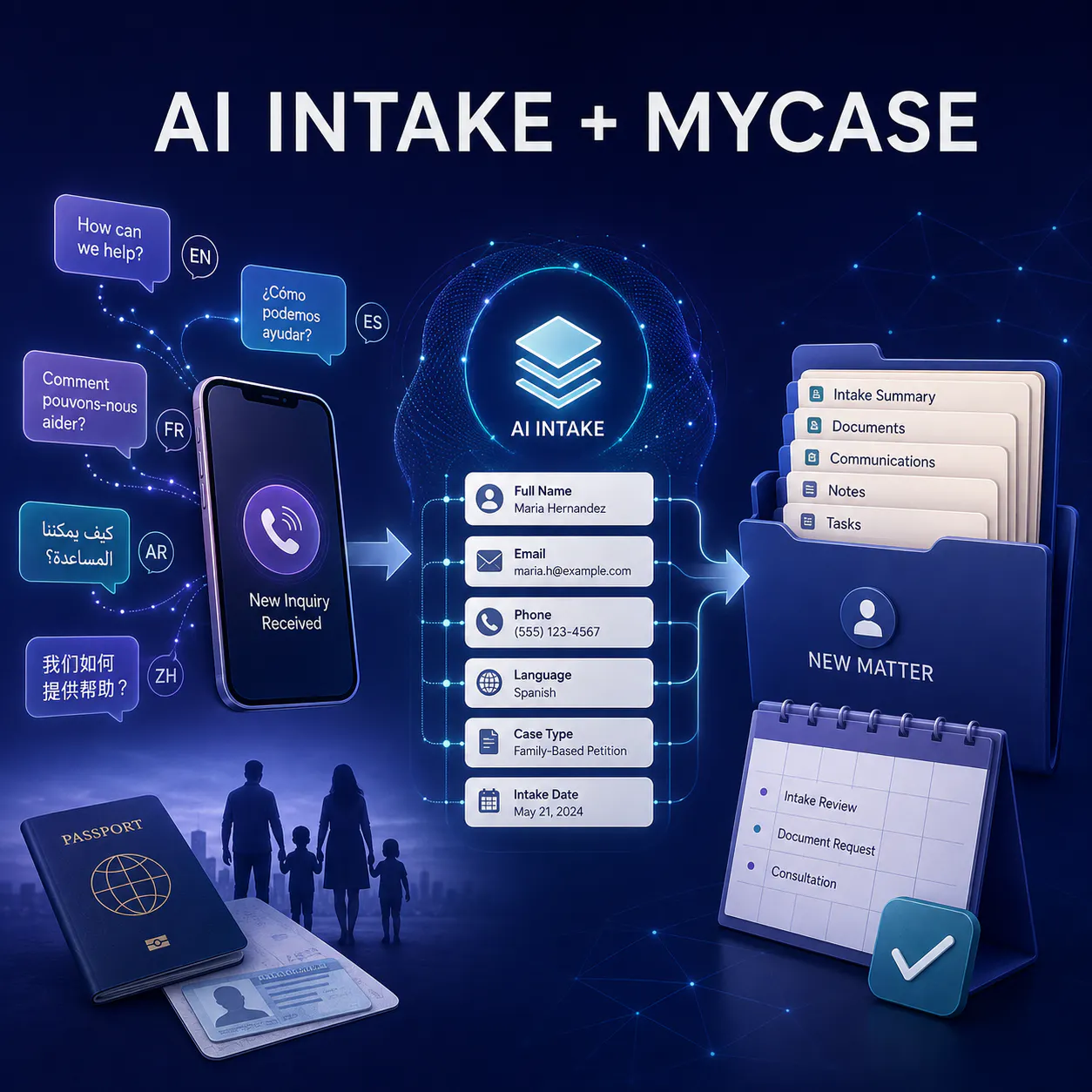
For immigration firms already using MyCase, Clerx can provide the first-response layer that answers calls, collects structured intake information, books consultations, and moves relevant information into the firm's existing MyCase workflow.
What AI Receptionist Works With MyCase for Immigration Law Firms?
For immigration firms already using MyCase, Clerx can provide the first-response layer that answers calls, collects structured intake information, books consultations, and moves relevant information into the firm's existing MyCase workflow.
By Attorney Michael Brunman, Co-Founder and CEO of Clerx
Clerx is an AI receptionist and intake platform that integrates directly with 8am MyCase. For immigration firms using MyCase, Clerx can answer inbound calls 24/7, use firm-defined questions to collect and qualify inquiries, schedule consultations on the firm's MyCase calendar, and sync contacts, call notes, recordings, and appointment information into MyCase. Clerx supports intake. It does not provide legal advice.
A caller may reach the firm while the attorney is in court. Someone may call after work in Spanish or Portuguese. A prospective client may be anxious about a hearing, government notice, expiring document, family petition, or change in status. If the first response is slow or unclear, that person may contact the next firm before the MyCase workflow ever begins.
This guide is for immigration firms already using MyCase
8am offers more than one relevant workflow for immigration firms. 8am DocketWise is purpose-built for immigration practices and combines multilingual intake and immigration forms with case management, billing, payments, and firm operations.
8am MyCase is a broader practice-management platform that serves multiple practice areas. It also offers immigration-specific capabilities, including Smart Forms, immigration fields, USCIS tracking, and e-filing through its Immigration Add-On.
Firms can also use the two systems together. According to MyCase's official integration documentation, MyCase and DocketWise can share contact and case information between the platforms.
This article explains how Clerx supports first response when MyCase is part of an immigration firm's workflow. DocketWise users can instead review the Clerx integration with 8am DocketWise.
Why MyCase users still need a first-response layer
For immigration firms that use MyCase, the platform can manage leads, matters, calendars, documents, client communications, billing, and ongoing legal work. It becomes most valuable once the firm has captured accurate information and created the appropriate record.
First response is a different job. It begins when someone calls and expects the firm to answer now.
Clerx handles that front-end layer, while MyCase remains the system where a MyCase-using firm manages the lead and legal workflow. The Clerx integration with 8am MyCase connects the two.
MyCase's official Clerx integration listing and integration announcement publicly describe capabilities that include:
- answering inbound calls day or night
- asking questions based on the firm's qualification criteria
- booking consultations on a MyCase calendar
- sending new contacts, call notes, recordings, and consultation information into MyCase
- collecting consultation fees or retainers through LawPay if enabled
The precise record creation and field mapping should be configured around each firm's workflow. The relationship is the same: Clerx handles first response and structured intake, and MyCase handles the lead, matter, and work that follows.
This is the practical role of an intake layer for MyCase users. It also explains why MyCase communication automation and live intake should be treated as connected but distinct functions.
Why immigration intake requires a specialized workflow
Immigration intake is often multilingual, time-sensitive, emotional, and document-heavy. The caller may not know the legal name of the process they need. They may be unsure which notice matters, which family member filed a petition, or whether a date creates real urgency.
A generic message-taking script does not give the firm enough structure. At the same time, the first call should not become a complete legal interview.
A better workflow identifies:
- the caller and reliable contact information
- preferred language
- general matter category
- current location
- known hearing, filing, expiration, or response dates
- whether the inquiry concerns a new or existing client
- the firm's defined routing outcome
- the appropriate consultation or follow-up path
The attorney decides which facts are operational screening questions and which require legal judgment. That balance is central to a seamless immigration client intake process.
Demand can also arrive in bursts. Policy changes, filing deadlines, news coverage, and enforcement developments can create heavy immigration call volume without warning. A solo attorney or a firm with three to five attorneys needs a workflow that stays consistent when the team is already busy.
From an inbound call to an organized MyCase record
The strongest integration is not merely a connection between two products. It is a defined journey with clear ownership.
1. The prospective client calls
Donna, Clerx's AI receptionist for law firms, answers using the firm's approved greeting and workflow. The call can be handled during business hours, after hours, or while staff are occupied.
2. The intake identifies the purpose of the inquiry
The first questions should classify the matter without attempting legal analysis. The workflow might ask who needs help, the general immigration category, preferred language, location, and whether the person knows of an upcoming date.
3. Firm-defined questions collect the minimum useful facts
A family-based practice may ask about the petitioner, beneficiary, relationship, current location, and prior filings. An employment practice may ask about the employer, role, current status, work authorization, and timing.
These are examples, not universal defaults. Each firm should configure the questions around the matters it accepts and the decisions staff need to make next.
4. The caller receives a clear next step
Depending on the firm's rules, the next step may be a consultation, staff review, call transfer, or follow-up. When the caller qualifies for a consultation, Clerx can book available time on the MyCase calendar. If LawPay collection is enabled, the workflow can also include the firm's payment step.
The scheduling step matters because many firms lose otherwise qualified prospects between first contact and the calendar.
5. The information syncs to MyCase
The public integration materials state that the workflow can send new contacts, call notes, recordings, and consultation information into MyCase. Staff can then review the record and continue from the practice-management system they already use.
6. The legal team takes over
Attorneys and trained staff remain responsible for conflict review, legal assessment, strategy, representation decisions, and advice. The value of structured intake is that the team starts with a cleaner record and a known next step.
An example immigration intake field map
An immigration firm might configure the handoff this way:
- caller name, phone number, and email to the MyCase contact
- preferred language and general matter category to intake details
- firm-approved screening answers and the conversation summary to call notes
- the call recording to the relevant record, based on the firm's configuration
- the selected consultation time to the MyCase calendar
- the LawPay transaction to the enabled payment workflow
- the recommended operational next step in a clear note for staff review
The firm should decide which data belongs in each location, who reviews it, and what happens when information is incomplete. Avoid collecting a long factual history simply because the system can ask more questions.
A progressive approach works better. Collect the minimum information needed to classify, route, and schedule the inquiry first. Use staff follow-up, the consultation, document requests, or a deeper form for the rest. The same principle applies to law firm intake forms: ask what is useful at the moment it becomes useful.
Multilingual and after-hours intake need clear rules
The U.S. Census Bureau reports that 22.3% of people in the United States speak a language other than English at home. For many immigration firms, language access directly affects whether a prospective client can explain the problem and understand the next step.
Clerx can support intake in English, Spanish, Portuguese, and more, depending on the firm's configuration. A strong multilingual workflow should use short questions, plain language, and careful confirmation of names, dates, phone numbers, and email addresses. It should also define when a bilingual staff member or attorney needs to take over.
The goal is more than word-for-word translation. It is a usable intake record and a clearer experience, as explained in Clerx's guide to multilingual AI intake for immigration firms.
After-hours rules deserve the same attention. A new inquiry that can be screened and scheduled is different from an existing client calling about a matter, a question that requires attorney review, or a circumstance the firm has defined for escalation.
Immediate response does not mean an immediate legal opinion. It means acknowledgment, structured information, and a clear next step.
Clio's 2024 secret-shopper study found that 48% of the law firms it tested were effectively unreachable by phone. The study was not limited to immigration firms, but it illustrates how often legal demand reaches a dead end. The practical lesson is consistent with Clerx's law firm response-time benchmarks: the firm's first-response process should work even when an attorney cannot personally answer.
What should remain human-led
AI intake supports responsiveness and consistency. It does not replace attorneys, trained staff, or legal judgment.
People should remain responsible for:
- legal advice and interpretation
- final conflict decisions
- case viability and strategy
- representation and fee decisions
- nuanced urgency assessment
- sensitive exceptions that need empathy or discretion
- review and correction of intake information
Before launch, the firm should test strong-fit and out-of-scope inquiries, language changes, existing-client calls, known deadlines, incomplete answers, and after-hours scenarios. Testing should confirm that the resulting MyCase record appears where staff expect it.
Measure the handoff, not just the number of calls
The firm should review whether the workflow moves qualified inquiries into consultations and retained matters with less delay and less manual cleanup.
Useful measures include:
- call answer rate
- time to first response
- intake completion rate
- inquiry-to-qualified-lead rate
- consultation booking and show rates
- lead-to-client conversion rate
- results by language, matter type, source, and time of day
- percentage of records requiring correction or staff follow-up
Definitions matter. A booking rate based on every inquiry is different from one based only on qualified inquiries. Clerx's guide to law firm intake metrics explains how to build a dashboard that reveals where opportunities are being lost.
How Clerx fits
For immigration firms using MyCase, Clerx provides a first-response layer across inbound calls, website chat, SMS, and other supported channels. Donna can answer calls, follow firm-defined intake criteria, support multilingual conversations, schedule consultations, and pass structured information into MyCase. MyCase remains the system for ongoing firm and matter management.
Final thought
A well-matched AI receptionist for a MyCase immigration firm responds reliably, follows the firm's rules, creates a structured handoff, and leaves legal judgment with people.
Questions immigration firms ask about Clerx and MyCase
Does Clerx integrate directly with 8am MyCase?
Yes. Clerx has a direct 8am MyCase integration. Public MyCase materials describe call answering, firm-defined qualification, MyCase calendar booking, and synchronization of contact and call information.
What information can Clerx send to MyCase?
Public integration materials list new contacts, call notes, recordings, and consultation information. The exact fields and record behavior depend on the firm's configuration.
Can Clerx book consultations on a MyCase calendar?
Yes. The integration can schedule consultations on the firm's MyCase calendar according to the availability and routing rules the firm configures.
Can immigration firms use MyCase and DocketWise together?
Yes. MyCase's DocketWise integration can share contact and case information between the platforms. Firms may also use either product according to their operational needs. This guide focuses on MyCase users.
Does an immigration firm need MyCase to use Clerx?
No. This article focuses on the Clerx integration with MyCase, but Clerx also integrates with 8am DocketWise and other legal systems. The appropriate setup depends on the firm's existing technology and workflow.
Can Clerx support multilingual immigration intake?
Yes. Clerx can support intake in English, Spanish, Portuguese, and more, depending on the firm's configuration. The firm should test each language workflow and define when human review is required.
Can Clerx answer immigration calls after hours?
Yes. Clerx can answer inbound calls 24/7. The firm defines which calls can be screened and scheduled, which need staff follow-up, and which should follow an escalation path.
Is Clerx appropriate for solo immigration lawyers?
It can be. A solo lawyer can use Clerx to reduce interruptions, create more consistent intake, and move structured information into MyCase. A narrow initial workflow is usually easier to review and improve.
Does Clerx replace immigration paralegals or attorneys?
No. Clerx supports first response, information collection, qualification, scheduling, and handoff. Attorneys and trained staff remain responsible for legal advice, conflicts, strategy, representation, and judgment.
How should a firm measure the integration?
Review response time, intake completion, qualification, consultation booking, show rate, conversion, and the amount of staff correction required. Segmenting results by language, matter type, source, and time of day can reveal where the workflow needs adjustment.
About the author
Attorney Michael Brunman is the Co-Founder and CEO of Clerx. He focuses on helping law firms use AI to build more responsive, consistent, and measurable client-intake operations.
Recommended Posts
10/9/2026
Law Firm Intake Quality Assurance: A Weekly Scorecard for Calls, Chat, and SMS
Law-firm intake quality assurance turns isolated call reviews into a repeatable operating system for finding lost opportunities, unsafe exceptions, and broken handoffs across every channel.
10/8/2026
Law Firm Warm Transfers: When an AI Receptionist Should Transfer, Book, or Take a Message
A law-firm warm transfer works only when the right caller reaches the right person with context, and when the workflow has a reliable fallback if nobody answers.